by Laurence | Apr 26, 2007 | Social search
Defining Web 2.0 remains something of a parlor game for bloggers. I was amused this morning to see a three-point summary that’s tongue-in-cheek — except not. Here’s point #3:
Unclear business model, pastel colors & large fonts used
Actually, most of the current Web 2.0 definitions seem overly complicated to me. Getting into specific delivery mechanisms, or specific software philosophies, seems unnecessary.
If its primary value to a user depends on the participation of other users, it’s Web 2.0.
by Laurence | Apr 26, 2007 | Competitors
While earlier Web 2.0-ish local sites have been dealing with shifting sands, new sites continue to appear. YellowBot is among the latter, and appears to be hanging its hat on tags.
What’s to like about YellowBot? Here are a few things:
- Tags are generally a good idea
- YellowBot has bought nationwide base data from Localeze, which means I don’t have to wait for users to build the site
- It has pre-seeded the tags
- Its location input box has a “suggest” feature that finds matching street addresses in real time, which I haven’t seen before
What’s not to like?
- The pre-seeded tags are a bit hinky, which makes them less useful. In fact, the site’s data seems shaky overall. More on this below.
- Despite the somewhat cool street-address feature, the location “suggestions” work rather weirdly. (Try typing in an address.)
- The site has virtually no user content, even in places where I’d imagine it should, such as its hometown of LA. It has imported some reviews from CitySearch, Zagat and possibly elsewhere, but this seems inconsistent.
- The editorial tone of the site is exclusionary, or possibly just dumb.
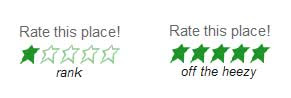
The tone is a problem because it’s grating and counterproductive. Maybe I’m getting too old, but I refuse on principle to rate anything as either “rank” (1 star) or “off the heezy” (5 stars):
 This tone is echoed in the FAQ:
Tags are the flava … of YellowBot.
Mmmm-hmmm.
Is it possible that some people think this is cool? I suppose so, but I can’t imagine YellowBot will get lots of reviews of lawyers and lawn-care services (both of which it touts on its home page today) from such an audience.
Other things will be harder to change. There’s the whole chicken/egg problem of sparse user content; I’ll post soon about that general issue.
And then there’s the data, especially as reflected by tags. I suspect that YellowBot bought its pre-seeded tag content, and the UI really plays it up. Some of it is useful, the rest … not so much.
As a minor example, my brother John runs a hot-dog joint on Hollywood Boulevard in LA. Skooby’s is famous for its hot dogs. YellowBot’s tags for the place, none of which appear to have been contributed by users, are as follows:
Bar Food – Burgers – dining – food – Pizza – restaurant
OK, I forgive the absence of “hot dogs.” But “burgers” and “pizza” are actively wrong. John serves burgers in his quasi-nearby Hermosa Beach location, but YellowBot doesn’t have that listing at all. He doesn’t serve pizza anywhere. If I search for “pizza” and get directed to Skooby’s, I’m being misled.
(I’ll find lasting consolation in LA’s best hot dog, fries and lemonade, of course.)
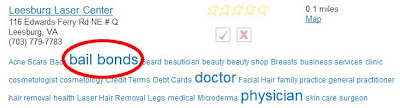
Some of the YellowBot tags appear to have been entered from Yellow Pages ads. Others are just a mystery. Here’s one medical place in Leesburg, VA:
And another:

It’s not just tags. The number-two result for a search on “doctor” in Leesburg, VA, is listed as follows:
Jackson River Orthopedics PC
I-64 Exit 21
Leesburg, VA
This business isn’t in Leesburg. I-64 goes nowhere near here.
Unfortunately, I didn’t have to look very hard for examples like this. I’m hoping that YellowBot will work out these kinks before long.
