by Laurence | May 25, 2008 | Local search, Loladex
Via Andrew Shotland, I recently saw this post. I know I’ll be called naive, but I was surprised at its blatancy.
This guy Stephen Espinosa (whom I don’t know) helps local businesses promote themselves online. His advice is to get your “clients” to post reviews on popular sites — the quote marks are his, and he adds a smiley face in case we don’t get it:

I won’t spell it out fully, since he doesn’t, but this seems like an opportune moment to talk about fake reviews.
You need spend only a few minutes on most rate-and-review sites to understand that they contain fake reviews. There are fake positive reviews posted by the business owners, and fake negative reviews posted by their competitors. Many are amateurish and easy to identify if you’re looking for them, though I suspect that some casual users don’t realize they’re fake.
I’ve never put much store in reviews by strangers. Still, I always thought that out-and-out fakes were a fairly limited and unorganized phenomenon. Now that I see they might be promoted more systematically, I’ve lost confidence that I can even spot a fake.
Furthermore, I expect that such fakery will spread and become more sophisticated. As local search reaches critical mass, it’ll be hard to trust anything.
I used to believe, for instance, that a Yelp reviewer with 10+ reviews and some kudos from friends was almost certainly a real person. That’s probably still a safe assumption — but will it be next year?
If I’m a certain type of SEO consultant, right now I’m probably setting up a network of hundreds of fake Yelpers. They’ll all have real-looking pictures, real-sounding profiles, and lots of reviews (some even genuine). They’ll send each other kudos, enhancing each others’ credibility.
And they’ll exist solely so I can be paid to deploy them for the benefit of my clients.
If done properly, this sort of fakery will be very hard to detect. Probably the only way I’d get caught would be to advertise the service — or to include quote marks and smiley faces when I blogged about it.
And this is just the truly fake reviews. There’s still reviews from friends of the business owner, and “real” reviews that have been solicited directly by business owners, some of whom will give discounts in exchange for posting on … well, on a certain site.
In such a world, reviews by strangers become devalued and personal trust is at a premium.
Not so long ago I heard that we need to see, on average, 20 reviews from strangers before we’ll believe the prevalent opinion that’s being expressed.
What will that number be in the future? 50? 100?
Wouldn’t it be simpler and better to get your advice from people you know and trust?
Via, say, Loladex?
by Laurence | May 21, 2008 | Competitors, Local search, Loladex, Social search
Why would anyone start using Loladex? We get asked this question a lot.
I’ve posted before about the chicken-and-egg issue, albeit in general terms. Probably I should update those thoughts: Since we started focusing on social networks, we’ve learned a bunch.
But for now, let me address Loladex’s specific challenge: How do we motivate people to rate local businesses via a Facebook application? Why would anyone do such a thing?
Well, for many reasons, of course. One day I’ll list them all. But I’d like to highlight one reason in particular, partly because I think it’s powerful and partly because it illustrates a big difference between Loladex and two of its biggest competitors — Yelp and Angie’s List.
Here it is: Loladex believes people will rate local businesses to help their friends.
By friends, I mostly mean actual, real-world friends. People you might have dinner with. For most folks, that’s a subset of “Facebook friends.”
Let’s get specific. Why would anyone use Loladex to rate, let’s say, a plumber? Or a pediatric gastroenterologist? Certainly it’s not something you do on a whim. Loladex won’t be running ads that say “Rate pediatric gastroenterologists!” — and if we did, we wouldn’t expect many clicks.
But suppose you were asked directly by a friend whose kid needed a medical specialist? If you knew of a good gastroenterologist, would you take a minute to make the recommendation? If you were seeking such a specialist, would you value this sort of recommendation?
We think so. Such recommendations are an everyday part of friendship, and numerous surveys tag them as a more powerful force than the Yellow Pages, a $14 billion industry.
With Loladex, we want to provide a channel for these person-to-person recommendations.
Contrast this to Yelp. I always say I like Yelp — and I do — but Yelp isn’t about helping your real-world friends. By and large, the people who rate businesses on Yelp do it for reasons of (a) self-expression; and (b) social standing in an online community that may overlap with their real-world friends, but doesn’t have to.
These mostly twentysomething Yelpers provide a service for us all, God love them. But it’s almost never a person-to-person transaction. Also, the motivation to rate something on Yelp fades quickly outside its core realm of restaurants & other social venues.
Or consider Angie’s List. I’m not a fan of Angie’s List, simply because it’s a subscription service. If it were free, I’d love it. They’ve built something that’s clearly valuable to their users — and they’ve focused their brand admirably, defining it around home services.
Again, though, Angie’s List isn’t about helping your real-world friends. It’s mostly a community of cooperating strangers who share ratings because they understand the value of the site’s virtuous circle. There’s an implicit quid pro quo.
Both Yelp and Angie’s List have powerful models. Loladex aims to tap many of the same motivations; we’d be silly not to. But mainly we’re about recommendations from your friends. We’re trying to bring this everyday personal interaction into your online world.
OK, so much for the theory. How’s the “help a friend” strategy working for us, specifically on Facebook?
To be honest, it’s a learning experience.
More in Part 2.
by Laurence | Apr 4, 2008 | Competitors, Local search, Social search
So who’s doing local search apps on Facebook? What follows is my brief impression of various local apps I’ve used in the past few months. I’m sure my list is incomplete. If I’ve missed something obvious, feel free to add it in the comments.
In my opinion, no one on this list competes with Loladex’s combination of functionality, comprehensive content and usability. Oh, and style. But of course I would think that.
This list is in no particular order.
MojoPages: Based on Jon Carder’s comments (see my earlier post), MojoPages is’t pushing this app anymore. It’s a bit of a shame, because (a) they put some thought into it, improving it since it launched some months ago; and (b) the MojoPages.com site continues to push some social aspects that are, in my opinion, better suited to Facebook than to their standalone version. It’s true that the FB app never got any traffic, and the execution still needs work, but I thought it deserved more promotion than they gave it.
Local Reviews: On its splash page, this app by eSesame claims to be “Facebook’s FIRST and LARGEST Local Reviews App!” Even if this was true once, by some measure, it isn’t anymore. It seems downright moribund, in fact. I find the interface a bit confusing and scattered, and the content is limited to a tight selection of categories and cities. Even in these areas, they don’t have comprehensive data — searching for Chinese restaurants in the Washington, DC area yields a single result, for instance. I guess they have just what their users enter?
Restaurant Reviews: As the name implies, limited to restaurants. This app comes from SuperPages.com, which is certainly a credible source, but it never got off the ground. I’m not sure why they restricted it to a single category since they have the whole phone book at their disposal, literally. The app is presented mostly as a way of browsing places that have reviews: You’ll need to click to uncover a search box. It’s mostly a window into user comments from the regular SuperPages site, so there are few associations with actual Facebook users. Not very social.
Local Picks: From TripAdvisor, the king of hotel reviews. Limited to restaurants, despite the generic name — base data from the worldwide but long-in-the-tooth ChefMoz database, perhaps, supplemented by members? (Someone correct me if I’m wrong.) Users appear to be griping that their additions and deletions aren’t processed quickly enough by TripAdvisor, which is also my experience with the TripAdvisor hotel database. Still, it must be said that this is a very nice Facebook app: Deep, engaging, well-designed. They are making an effort, and they have more users than most local apps. TripAdvisor also makes the “Cities I’ve Visited” app, which is far more popular but not nearly as useful.
iVouch: I recall that this app used to be a local thing, where users “vouched” for businesses, but lately it’s about users vouching for each other. The local aspect still exists, but has been subordinated. It’s not particularly useful, in any case, as I can’t search for places that others have vouched for. Or I don’t think I can, anyway. Strange. Either the app isn’t fully conceived or I’m missing something.
Search Local: This is a fairly straightforward Yellow Pages app, except that it doesn’t seem to have much data. (Or maybe its search doesn’t work properly.) Its main distinction is that it wants to broadcast all your searches to your friends’ news feeds. This may or may not be good for virality — not, I’d guess, based on its traffic — but either way it’s a bad idea. No one wants this stuff to be public by default. They have an opt-out checkbox, but it’s easy to forget and I can’t set it to opt out permanently.
DoYa? This app has some of the same ideas as Loladex. They’re trying to jump-start virality by offering $10 Amazon gift cards to people who “share” five recommendations with 10 friends. Depending on how many of those friends become DoYa users, it might make sense. I’m not crazy about the interface, but that’s mostly a matter of taste. They’re on the right track.
Eat It! Is this app working as designed? It’s a restaurant-only product by big ol’ CitySearch, and someone spent time on it, but it lacks all of CitySearch’s deep content for each listing — no information about restaurant hours, no professional reviews, no user ratings, no photos, nothing. Just an address. Whole features like “QuickRate” appear to be pretty much broken, too. Weird. I have a vague memory that it used to work, but until today I hadn’t visited it for months. Maybe its creators haven’t visited lately, either?
Eating: Yet another restaurant-only app, this one by Menuism. It doesn’t take a local-search approach, exactly; it’s got a less utilitarian, more social vibe — more like one of the various “bookshelf” applications on Facebook, where people participate to express themselves and share their interests. Or like Yelp, except with more bona fide social networking. That’s my take, anyway. Like Loladex, it incorporates Facebook networks, which is a good way to open up more friend-like content. Data is far from comprehensive, however, and the sync to the “real” Menuism site seems imperfect.
Restaurants: Bulit by our neighbors in the nation’s capital, Hungry Machine LLC, creators of Visual Bookshelf. Once again, restaurants only. Once again, data is far from comprehensive. Annoying popups that ask me to invite friends. I don’t have many friends on the app, so it’s not clear to me whether their recommendations count more than those of strangers. Be nice if they did. (Anyone know?) Generic food photos are used to illustrate specific restaurants, which can be misleading: Our local chain Ledo Pizza, for instance, is known for its square pizza; they probably aren’t thrilled to be represented by a round pie. I’m not a fan of the overall design, which is busy, but the underlying functionality seems solid.
Following are some other apps that I haven’t used much yet, but that may be worth a look. None are “big” by Facebook standards.
[Added after initial post] Hangouts: OK, so this is Yelp’s application. It’s not a local search, just a way of broadcasting what you’re supposedly doing this evening, with a search that sometimes helps you link to the right listing. It launched fairly soon after the Facebook platform launch, and has the air of a side project rather than a committed effort. Functionality is shallow and requires going to Yelp.com for detail on listings. I could be wrong, but it seems to have been abandoned by Yelp. I assume that if they ever return to Facebook it’ll be with a different approach.
My Restaurants: A modest app that seems like it’s doing many things right.
Eat-a-Rama: Bills itself as the “top-rated restaurant application on Facebook,” whatever that means. At a glance I’m not a fan: Overdesigned & gimmicky. Someone is working hard, though.
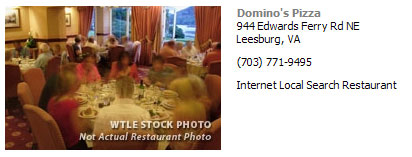
iEat: This app doesn’t really appeal to me, either, but it’s a bit interesting because it has a two-level search. If it doesn’t find a restaurant in its database (a likely scenario, it seems), it does an “Internet search” and returns matches from … well, somewhere or other. I enjoyed the stock photos shown for each restaurant; see the one for Domino’s below:
While I’m at it, I should mention a few notable absences:
Yelp: As far as I know, Yelp has no app on Facebook. A few third-party apps try to track or broadcast your Yelp.com activity. See above; thanks, Jon.
Zagat: Zagat has a Facebook app, but it’s for use by restaurants rather than regular folks — the virtual equivalent of putting a “Zagat rated” sticker in your restaurant’s window.
Angie’s List: Not terribly surprising that AL doesn’t have an app; as a subscription site, it doesn’t really translate.
(Continued in Part 3)
by Laurence | Feb 27, 2008 | Competitors
At least today’s story has a hook: Yelp just announced another round of funding, raising $15 million not because it needs the cash but because, per CEO Jeremy Stoppelman, “it’s a shaky world out there.” Well, OK.
TechCrunch tosses out a valuation of $200 million on revenue of less than $10 million, and notes (correctly) that Yelp has been on a traffic tear lately. Still not profitable, says the Post.
One interesting thing was the photo:

This is a local Virginia business giving some TLC to a group of the ‘Yelp Elite,’ which is Yelp’s clubby moniker for those it has anointed as cool kids.
I’m not a fan of the Yelp Elite concept, in part because it works only for twentysomethings, but there’s no doubt it drives engagement. Smart businesses like this health club in McLean are leveraging that engagement, while Yelp acts as the broker.
I don’t think this strategy will prove cost-effective for Yelp, but it’s definitely interesting to watch.
I continue to be fascinated, too, by the way Yelp has become a platform for self-expression. Above all, I believe, the ‘Elite’ visits Yelp in order to write artful reviews—not to read them.
It’s a different dynamic than the one we’re trying to tap at Loladex, where the substance of people’s opinions will take precedence over their mode of expression. We think this will scale better, but it’s certainly tough to argue with how Yelp is doing so far.
by Laurence | Sep 19, 2007 | Local search
Yellow Pages folks surely do love structure — especially when it comes to data. Here at the latest Kelsey conference, where YP folks abound, the only good datum is a structured datum.
Consider the title of yesterday’s most interesting panel:
Building a Better Database: Acquiring Content in a Dysfunctional Environment
The title is a bit grad school, but “dysfunctional” is a strong word that caught my eye. Here it mostly means “resistant to structure.”
And them’s fightin’ words in the world of Yellow Pages.
By now I’ve gone to a bunch of YP-oriented conferences. All of them featured a discussion about how to gather structured data. But I’m starting to suspect that this isn’t the most important problem to solve — and not just because these conference discussions never go anywhere.
Here’s my thinking:
In what a YPer would call a functional environment, every business location, small or large, would authorize a regularly updated master version of its “attributes” (hours, certifications, parking facilities, etc.), and would post this information in some microformat on its Web site, or supply it directly to each data vendor, or send it to an industry-wide data clearinghouse that’ll probably never exist.
In addition, lots of other data sources — licensing bodies, rating sites, whatever — would distribute structured information that’s already normalized and can be correlated perfectly to these master records.
All this data would then be collated by data vendors such as Localeze and sold to Web companies such as Google or, for that matter, Loladex.
Finally, the Web companies would build applications that use the structured data for searching by consumers (input) and display to consumers (output).
This worldview may be summarized thus:
More structured data in → Better answers out.
Or as Marchex‘s Matthew Berk (who’s a smart guy) said at the panel here: “We think local search is about structured search.”
Berk gave a very good example, which I also use when discussing Loladex: If you’re looking for a doctor, you need to know whether he takes your insurance. That’s true, without a doubt.
But here’s the problem I have:
The majority of information available about any company, and particularly about any small company, will never be structured. It’ll exist only on the general Web, where it must be searched on its own terms — that is, as unstructured text.
To me, this suggests that the most pressing data problem isn’t how to gather more structured data, but how to search unstructured data (on Web pages) and return structured answers.
I live on both sides of this equation, by the way. My wife runs a small cookie bakery, and I’m in charge of distributing her data to online sources.
Because of my background, I’m more informed and motivated than most small business owners. And yet, to be honest, just keeping her Web site up-to-date is a chore. On Yelp right now, I’m sorry to say, her hours are incorrect. I should update it, but I just haven’t.
Accuracy on our own Web site is always my #1 priority, because that’s our official voice. Also it’s where most people land when they search for “Lola Cookies.”
Keeping Yahoo Local accurate is on my list, too, but it’s lower down. Ditto Google and YellowPages.com and the other big sites.
I never think about the data vendors one layer back, like InfoUSA, unless they happen to call the store. (Which InfoUSA does, to its credit.)
Meanwhile, plenty of interesting and searchable information about the bakery exists in other places on the Web, in formats that aren’t even addressed by the concept of “attributes.”
A TV broadcast from the bakery aired live on the local morning news recently, for instance. If you watched the show, you might search for us with a term like “fox 5 cookies virginia.” Where does that fit in the world of structured data?
I raised this general issue at yesterday’s panel. What were the panelists doing about this wealth of unstructured Web data, which right now is the dark matter of the local-search universe?
The answer I got was, basically, “Not much.”
Most panelists said they do only highly targeted crawls, focusing on sites that have structured data that can “extend or validate” their own data, in the words of Localeze’s Jeff Beard. An example might be the site of a professional group such as the American Optometric Association.
No panelist was ready to start indexing the sites of individual businesses, or locally focused blogs, or any other sites that are unstructured but potentially rich in content.
The only (mild) exception was Erron Silverstein of YellowBot, who also said his company limits itself to targeted crawls — but included local media, such as newspapers, among his targets.
A few players are indexing the broader Web and then associating pages with specific businesses (which is the important part). Most notable are Google and Yahoo, who do it for their local search products.
Of course, they’re already indexing the entire Web. It’s less of a stretch for them.
Google and Yahoo also buy structured data from InfoUSA, Localeze and others, so it’s not like such data is obsolete. But they’re getting the same info directly from some businesses, and those updates are likely more timely, more accurate, and more complete.
Meanwhile, their Web indices are opening up a realm of data that traditional vendors like Acxiom — represented by Jon Cohn on yesterday’s panel — simply don’t care to address.
I suspect that, sooner than you’d imagine, Google and Yahoo will be buying structured data not so that users can search it directly, but for two less-flattering reasons:
- To help find Web pages they can associate with each business
- To fill ever-smaller gaps in the coverage that results from #1
Matthew Berk of Marchex argued that a good local search must be structured to “help someone walk down the decision trail” by using filters to narrow their search progressively:
I need a orthopedist in Boston … in the Back Bay … who accepts United Healthcare.
I think users are more likely to learn that they can go to Google and type “orthopedist back bay united healthcare” — particularly if it produces a good top result the first time they try.
The burden of local search, it seems to me, is to do something that Google can’t match with an unstructured Web search.
In any case, the search portals will ultimately use their indexed Web pages to extract and cross-check structured data directly. Over time — probably just a couple of years — such automated processes will yield data that’s more current and detailed than anything that’s produced by scanning phone books or calling stores.
The resulting search functionality, integrating both structured and unstructured data, will be sold to other companies as a Web service, and data vendors such as InfoUSA will become irrelevant to local search.
Now that would be a dysfunctional environment for many of the Kelsey attendees.
I’m not sure exactly how companies like InfoUSA and Acxiom should tackle the unstructured Web. It’ll demand a new way of thinking, and probably a new way of selling.
But I’m certain that they ignore unstructured data at their peril.